Workers gather near a scaffold, hard hats on, clipboards in hand. The foreman pulls out a printed sheet—today’s toolbox talk PDF—and starts reviewing fall protection procedures. This scene repeats thousands of times daily on job sites worldwide. Yet, all too often, these safety talks become routine, rushed, or forgotten.
A toolbox talk PDF isn’t just a formality. When used correctly, it’s a powerful tool for preventing accidents, reinforcing protocols, and documenting compliance. But too many teams use outdated, generic, or poorly structured PDFs—or worse, none at all.
This guide cuts through the noise. You’ll learn how to select, customize, and deploy effective toolbox talk PDFs that workers actually engage with—and why the right template can be the difference between compliance and catastrophe.
Why Toolbox Talk PDFs Matter in Safety Programs
Toolbox talks are short, informal safety meetings typically held at the start of a shift. They focus on a single hazard, procedure, or safety rule. The PDF version serves as both a script for the supervisor and a record for the organization.
Unlike lengthy safety manuals, PDF talks are digestible—usually 1 to 2 pages. They’re designed to be printed, projected, or viewed on tablets. Their portability and consistency make them ideal for daily use across construction, manufacturing, utilities, and oil and gas.
Key benefits include: - Standardization: Ensures every crew receives the same core message. - Documentation: Signed attendance sheets prove compliance during audits. - Engagement: Visuals, checklists, and real-world examples keep workers involved. - Risk reduction: Addresses emerging hazards before incidents occur.
Without a structured PDF format, talks often devolve into vague reminders. “Be safe today” doesn’t cut it. A well-designed PDF delivers clarity, accountability, and actionable takeaways.
What Makes a High-Quality Toolbox Talk PDF?
Not all PDFs are created equal. A top-tier template balances structure with flexibility. It guides the presenter without reading like a robotic script.
Essential components of an effective toolbox talk PDF:
| Element | Purpose |
|---|---|
| Clear title and topic | Instantly communicates the focus (e.g., “Electrical Safety in Wet Conditions”) |
| Objective statement | Explains why this matters today |
| Key hazards | Lists 3–5 specific risks related to the topic |
| Safety controls | Details PPE, procedures, and engineering controls |
| Discussion prompts | Encourages interaction (e.g., “Has anyone seen this hazard before?”) |
| Sign-off section | Includes names, roles, and signatures for audit trails |
| Visual aids | Diagrams, icons, or photos to reinforce learning |
Avoid PDFs cluttered with legal jargon or overly technical language. Your audience is field crews, not lawyers. Use plain English. For example, instead of “mitigate electrocution risk,” say “don’t use damaged cords near water.”
Also, ensure the PDF is mobile-friendly. Many supervisors use tablets or phones on-site. If the text is too small or the layout breaks on screen, it defeats the purpose.
Top 5 Toolbox Talk PDF Resources
Finding reliable, customizable templates can save hours. Here are five proven sources offering free or paid PDFs trusted by safety managers:
- OSHA.gov
- _Best for compliance alignment_ Offers free, downloadable PDFs directly from OSHA’s website. Topics include fall protection, scaffolding, and hazard communication. Pros: Authoritative, legally sound, no cost Cons: Less visually engaging, limited interactivity
- Creative Safety Supply
- _Best for visual learners_ Provides professionally designed PDFs with infographics, icons, and bilingual options. Pros: High readability, includes PPE checklists, regular updates Cons: Requires email sign-up for full access
- SafetyNow
- _Best for digital integration_ Offers PDFs compatible with their app, allowing e-signatures and cloud storage. Pros: Seamless digital workflow, attendance tracking Cons: Full features require paid subscription
- Safe Site Checklists
- _Best for construction teams_ Specializes in trade-specific talks—welding, excavation, crane operations. Pros: Niche topics, real-world scenarios, editable formats Cons: Some templates are paywalled
- HSE Website (UK)
- _Best for international standards_ The UK Health and Safety Executive provides clear, concise PDFs adaptable globally. Pros: Simple language, focus on practical behavior Cons: Not OSHA-specific, metric units used
Choose a resource that matches your industry, regulatory needs, and delivery method. For example, a union contractor may prefer OSHA-aligned PDFs, while a tech-forward crew might invest in a digital platform like SafetyNow.
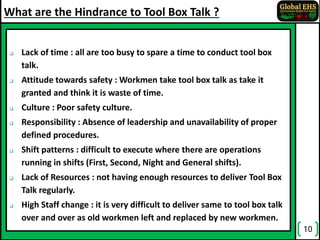
Common Mistakes That Undermine Toolbox Talk PDFs
Even with a great template, poor execution renders the effort useless. Here are recurring pitfalls:
- Reusing the same topic monthly
- Workers tune out when they hear “PPE Basics” for the third time in a row. Rotate topics based on seasonal risks, recent near-misses, or project phase.
- Skipping the sign-in sheet
- No signature = no proof. During an OSHA inspection, missing attendance records can trigger citations—even if the talk happened.
- One-way delivery
- Reading a PDF verbatim kills engagement. Use the document as a guide, not a script. Ask questions, share site-specific examples.
- Ignoring local conditions
- A generic “slip and trip” PDF won’t address muddy trench edges on your current site. Customize the hazard list and controls.
- Failing to archive
- Old PDFs pile up on desktops or get tossed. Store them digitally with clear naming:
2025-04-15_TBT_Fall_Protection_SiteB.pdf.
Fix these gaps, and your toolbox talks shift from box-ticking to real risk reduction.
How to Customize a Generic PDF for Maximum Impact
A template is a starting point. To resonate with your crew, you must tailor it.
Step-by-step customization:
- Review the standard template
- Start with a reliable base PDF (e.g., from OSHA or Creative Safety Supply).
- Add site-specific details
- Insert project name, location, and date. Reference actual equipment on-site.
- Update hazard examples
- Replace generic risks with recent observations. For instance: “Last week, we saw loose rebar caps on the east deck—today we reinforce cap usage.”
- Include photos
- Snap a picture of a hazard (e.g., frayed extension cord) and add it to the PDF. Visuals increase retention by up to 65%.
- Adjust language for literacy levels
- Simplify terms. Use bullet points, not paragraphs.
- Add a “Lessons Learned” section
- Link the topic to a past incident—without blaming individuals. Example: “After the near-miss with the forklift last month, let’s review blind spots.”
Customized PDFs feel relevant. Workers are more likely to listen, respond, and apply the lesson.
Integrating PDFs Into Your Daily Workflow
A toolbox talk shouldn’t disrupt the workday. Build a repeatable process:
- Schedule in advance
- Plan topics weekly. Align with current tasks—e.g., “Confined Space Entry” before tank cleaning.
- Assign presenters
- Rotate supervisors or lead workers. Encourages ownership and fresh delivery.
![[PDF]The Best 33 Safety Topics for Daily Toolbox Talk in PDF format](https://1.bp.blogspot.com/-RuFUi5rqwag/XOUlrK5kFRI/AAAAAAAAIoQ/K_Pm-bDiNoA1lLEKaQcfRIXN396_ZWcMgCLcBGAs/s1600/Tool%2BBox%2BTalk%2BTopics_Page_2.png)
- Use digital tools
- Tablets with PDF readers allow annotation and instant archiving. Apps like Dropbox or Google Drive sync across teams.
- Distribute early
- Email the PDF the night before. Presenters can review; crews can anticipate the topic.
- Store securely
- Maintain a master folder organized by month. Back up to cloud storage.
For larger sites, consider a digital safety platform that logs talks automatically. However, a simple, well-managed PDF system remains effective—and far better than nothing.
Real-World Example: Preventing a Fall Incident
A mid-sized contractor was installing roof trusses. The standard “Fall Protection” PDF was used weekly, but incidents persisted.
After a close call—a worker nearly stepped through an unguarded opening—the safety manager revised the approach:
- Customized the PDF to include photos of their specific truss design.
- Added a checklist for anchor point verification.
- Included a crew discussion question: “Where are the most dangerous edges today?”
- Required initials next to each PPE item on the form.
Within two months, near-misses dropped by 70%. The change wasn’t the topic—it was the relevance of the PDF.
Choosing the Right Format: PDF vs. Digital Platforms
While PDFs dominate, digital tools are rising. Here’s how they compare:
| Feature | Digital Platform | |
|---|---|---|
| Cost | Free or low-cost | Often subscription-based |
| Offline use | Yes | Limited without signal |
| Customization | High | Varies |
| Attendance tracking | Manual (signatures) | Automated |
| Reporting | Self-managed | Built-in analytics |
| Accessibility | Universal | App-dependent |
For small teams or budget-conscious firms, PDFs are still the best choice. For enterprises needing real-time reporting and integration, digital platforms justify the cost.
But never assume digital is superior. A poorly used app is worse than a well-managed PDF system.
Final Recommendations: Make Your Toolbox Talk PDFs Work
A toolbox talk PDF should do more than satisfy compliance. It should change behavior.
Start by auditing your current materials. Are they generic, outdated, or ignored? Replace them with targeted, visually clear templates from trusted sources.
Customize each one. Tie it to real site conditions. Encourage discussion, not monologue. Archive every session.
Train supervisors to use the PDF as a tool—not a chore. A five-minute talk with engagement beats a rushed 10-minute lecture.
The best safety cultures don’t just have PDFs—they use them well. Make yours one of them.
FAQ
Where can I download free toolbox talk PDFs? OSHA.gov, Creative Safety Supply, and the UK HSE website offer free, high-quality PDFs for various industries.
Can I edit toolbox talk PDFs? Yes—many providers offer editable PDFs or Word versions. Always keep the original source credited and ensure edits don’t compromise safety accuracy.
How long should a toolbox talk PDF be? Ideally 1–2 pages. Focus on one topic, with clear headings, bullet points, and space for signatures.
Should toolbox talk PDFs be in multiple languages? Yes, if your workforce speaks different languages. Bilingual PDFs improve understanding and compliance.
What topics should I cover in toolbox talks? Rotate through core hazards: fall protection, electrical safety, PPE, excavation, rigging, and site-specific risks like noise or chemical exposure.
Do I need to keep signed toolbox talk PDFs? Yes—retain them for at least one year (or longer per company policy). They serve as legal proof of training during inspections.
Can I use the same PDF for different crews? Yes, but customize it for each site or shift. Add location-specific hazards and examples to maintain relevance.
FAQ
What should you look for in Toolbox Talk PDFs: Templates, Topics, and Best Practices? Focus on relevance, practical value, and how well the solution matches real user intent.
Is Toolbox Talk PDFs: Templates, Topics, and Best Practices suitable for beginners? That depends on the workflow, but a clear step-by-step approach usually makes it easier to start.
How do you compare options around Toolbox Talk PDFs: Templates, Topics, and Best Practices? Compare features, trust signals, limitations, pricing, and ease of implementation.
What mistakes should you avoid? Avoid generic choices, weak validation, and decisions based only on marketing claims.
What is the next best step? Shortlist the most relevant options, validate them quickly, and refine from real-world results.